Michael J. Miller is a composer, conductor, and educator living in Horse Cave, KY.
His many works for concert band, orchestra, and chamber ensembles are available from Alfred Music, Carl Fischer Music, F.J.H. Music, Excelcia Music, Murphy Music, and R.W.S. Music. They regularly receive critical acclaim including J.W. Pepper and Son's Editors' Choice, Bandworld's Top 100 New Works for Band, and Highly Recommended status by the National Band Association's magazine, The Instrumentalist. Michael's music is performed nationally and abroad, including recent performances at the Midwest International Band and Orchestra Clinic in Chicago, the World Association of Symphonic Bands and Ensemble’s summer conference, and the Pacific Symphonic Wind Ensemble’s composer initiative.
Before dedicating himself to composition full time, Michael was a public-school band director. From 2013-2018 he served as the Director of Bands at Joe E. Newsome High School in Lithia, FL. Under his leadership, Newsome earned the Florida Bandmasters Association’s Otto Kraushaar award, was named B.O.A. Regional Grand Champions, qualified for W.G.I. World Championships Finals, and performed in theMacy's Thanksgiving Day Parade. Before his appointment at Newsome, he was Assistant Director of Bands at Robert Vela High School in Edinburg, TX, and the Director of Bands at Weeki Wachee High School in Weeki Wachee, FL. While at W.W.H.S., he was awarded the School Board of Hernando County’s Hernando H.E.R.O.E.S. Award, and the Superintendent’s Excellence Award. Additionally, he received the National Band Association's Certificate of Merit for outstanding contributions to marching bands.
Michael adjudicates and designs for pageantry ensembles across the United States. He currently serves as an adjudicator for Bands of America, is the brass arranger for the Colts Drum & Bugle Corps, and music arranger for Virtual Arts, Inc. His music for college marching band has been performed during halftime at Superbowl XLVIII, as well as during numerous B.C.S. Bowl games. Prior to joining Colts’ educational staff, Michael was a visual technician for the Blue Stars Drum & Bugle corps, a conducting drum major and trumpeter for the Boston Crusaders Drum & Bugle Corps, and played mellophone for the Syracuse Brigadiers Drum & Bugle Corps.
Michael holds a Master of Music degree in Instrumental Conducting from the University of Florida and a Bachelor of Music Education degree from Syracuse University. As a graduate teaching assistant for the University of Florida bands he guest conducted the Wind Symphony, Symphonic Band, and Concert Band, taught undergraduate conducting lessons, and was a staff member and music designer for Florida's Marching Band.
Michael is a member of the Music Educators National Conference, the National Band Association, the World Association for Symphonic Bands and Ensembles, and is a brother of Phi Mu Alpha Sinfonia. He is happily married to his wife and best friend, Vivian. When he isn’t writing music or working with a musical ensemble, he enjoys traveling the world and experiencing the food culture wherever he goes.
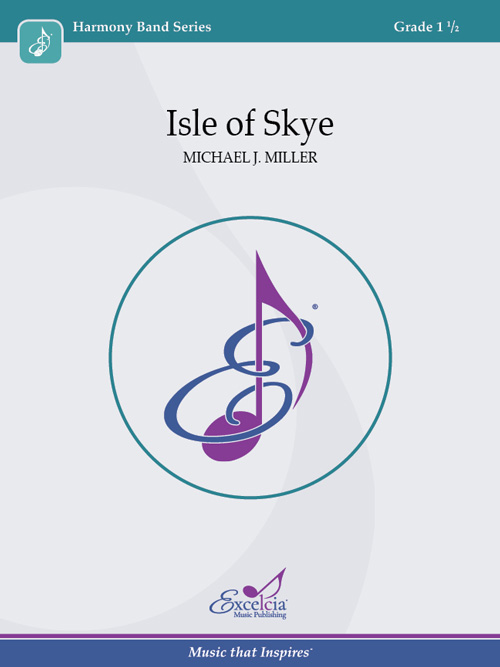
ISLE OF SKYE recorded by Excelcia Music PublishingISLE OF SKYE published by Excelcia Music Publishing
Skye Isle is located in the Inner Hebrides archipelago on Scotland’s west coast where it is both the largest and northernmost island. Known for its picturesque landscapes, castles, and wildlife, it is frequently visited by tourists from all over the world. This piece is a setting of the Skye Boat Song, a beautiful Scottish folk tune in triple meter. The lyrics recount events after the British Army defeated the Jacobites at the battle of Culloden when Prince Charles Edward Stuart is said to have retreated by boat to the Isle of Skye.
The Storr on the Trotternish peninsula in Skye
Speed bonnie boat like a bird on the wing Onward the sailors cry. Carry the lad that’s born to be king Over the sea to Skye
Loud the wind howls Loud the waves roar
Thunderclaps rend the air Baffled our foes Stand by the shore Follow they will not dare
Speed bonnie boat like a bird on the wing Onward the sailors cry. Carry the lad that’s born to be king Over the sea to Skye
Many’s the lad fought on that day Well the claymore did wield When the night came Silently lain Dead on Colloden field
Speed bonnie boat like a bird on the wing Onward the sailors cry. Carry the lad that’s born to be king Over the sea to Skye
I discovered this tune when my wife introduced my to “Outlander,” a series on Starz. The show follows protagonist, Clare as she slips through time into 18th century Scotland during the time of the Jacobite uprising and falls in love with James Fraser. Disclaimer: parental discretion advised for the series.
“Outlander” Season 1 opening title
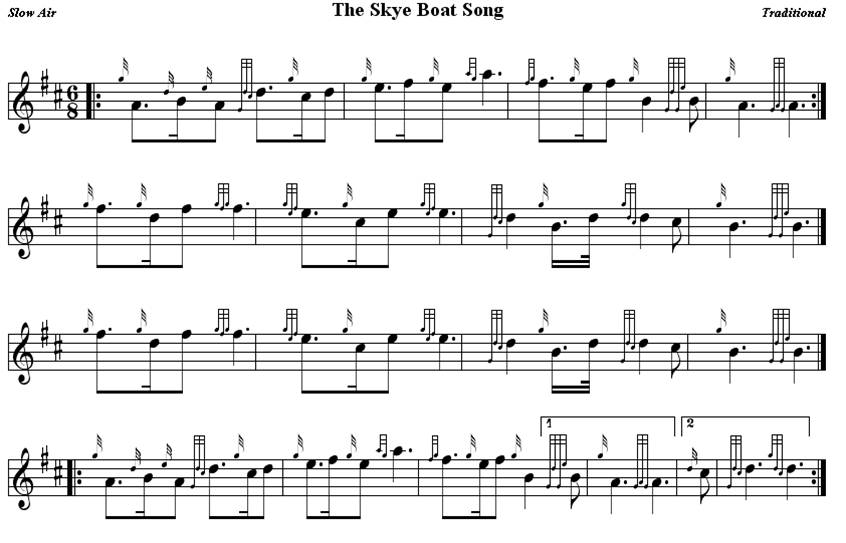
Mostly pentatonic, the melody is in rounded binary form (A-B-A) where the A theme rises and falls to and from the dominant scale degree while tonicizing an Ionian mode, and the B theme leads downward over the relative Aeolian mode.
Skye Boat Song scored for bagpipes
My arrangement begins with an eight measure introduction consisting of cascading intervals pitched in the E-flat major pentatonic scale. Supported by metallic mallet instruments, the opening line moves from the high woodwinds down through the mid voices and into the lows before arriving on a half cadence with the third omitted. This is followed by a six measure slow march feel in triple time utilizing some chromatic neighbor chords sounding the tonic.
The first utterance of the A theme is heard in the trumpets and is supported by the low winds and percussion. Extended harmonies are used to portray a tone of power and poise like that of the Jacobite Army. The B theme is then played by high winds and mallet percussion before a phrase extension and ritardando swell into a full ensemble restatement of the A theme. Here, the trumpets again play the melody with various counterpoint based on both the A and B themes passed throughout the rest of the ensemble. This climaxes after a stately ritard on a deceptive cadence in G-flat major before a solo trumpet settles back into a recapitulation of the opening materials in E-flat major. The final cadence, from B-flat dominant seven to E-flat major is the only perfect authentic cadence in the entire piece, and gives the final measures a sense of completion and restfulness.
I’ve become increasingly interested in the relatively new genre of indoor winds. For the unfamiliar, an indoor winds group is essentially a marching band that performs inside. Or is it?
I recently started designing for these groups, so I decided to spend an entire day (10:00am-7:00pm) watching the preliminary round of Winter Guard International’s Winds World Championships.
Disclaimer: I don’t for a second claim to be an authority on show design, and I’m in the very early stages of learning and developing my craft as a composer.
With that said, I’ve compiled this list of observations from my day watching indoor winds. They’re biased by 15 seasons as a performer, 8 years as a band director, and some 30 years as a fan and spectator. Most of them are specific to the indoor winds idiom, though some can be applied unilaterally across the pageantry arts.
Setting up the floor, props, and equipment is part of the show. “You’re always performing.”
The indoor arena is more intimate than the outdoor arena. Spectators are much closer to the performers. This give performers a great opportunity to connect to their audience.
Like a good outdoor design, an indoor design needs to be more than just drill and music.
Acoustic percussion instruments can be used as a texture, but a traditional front ensemble set up isn’t necessarily needed. A well produced electronic soundtrack can be equally if not more effective. However, if a smaller school is putting together an indoor winds show and most of the band is participating, then having a larger percussion section might make sense. Regardless, the winds should be the focus.
Similarly, a smaller program without a winter guard may incorporate a few guard performers in their indoor winds production. If used, guard performers need to be artistically integrated. It can’t just be guard for guard’s sake. Indoor winds groups, unlike a marching band don’t necessarily need guard performers for visual effect. Wind musicians can be trained to be just as expressive with their bodies, and smaller moveable props can be used by wind musicians. The instruments don’t always have to be in their hands!
Electronic soundtracks can enhance the musical score, but can also easily dominate it. Use sparingly and be sure to carefully balance levels. If the soundtrack is too loud it will diminish the winds’ output.
Sounds used in a soundtrack are most effective when they’re professionally sampled. Stay away from basic MIDI sounds if possible.
The soundtrack can and should be used to help keep time. However, there doesn’t always have to be a “drum beat.” Tempo-synced textures work just as well, and so do melodic ostinati. In any case, try to avoid patterns that repeat for long periods of time without variation.
Mics can be used to feature soloists and small ensembles. You can even add an effect patch to stylize things a bit further.
A small group of performers on the back of the floor for triggering samples, etc. can be integrated into a prop or hidden so they don’t stand out as much.
Unaccompanied moments with little to no soundtrack provide a nice contrast to full ensemble moments. And most indoor venues have a natural reverb.
Indoor venues are smaller than football fields. They can easily feel crowded with too many performers, but can also feel empty if there are too few. Stationary props can help frame a floor and make a small ensemble look larger.
An effective show has a variety of solo, soli, and tutti passages. “Variety is the spice of life.”
Melody is important. Without melody, there’s little direction to the music. Melody makes a show memorable. The audience should leave your performance humming a tune.
The acoustics in an indoor venue are unique. Most things tend to sound louder, and sounds resonate longer. When scored right, woodwinds can have a bigger presence than they do outdoors. This allows them for more opportunities for exposure.
A good show, like a good story, has an arc to it. Pacing throughout, and an effective ending can make or break a show.
In closing, the indoor winds activity is an infant. It is slowly finding its place among the well established guard and percussion genres, and is trying to distinguish itself from marching band. Also, many formally trained music educators disagree with its existence (at least in the scholastic realm). This may need to be a separate blog post one day – stay tuned! Regardless, it’s another outlet for young people to perform, make music, and build lasting relationships. I can’t wait to see how it develops over the ensuing years, and am looking forward to designing more shows!
PURPLE MOUNTAIN HEATHER recorded by Excelcia Music Publishing
Folk music has long been a source of inspiration for composers. Many melodies of more than several hundred years of age have survived in part due to their incorporation in modern music, and also because they are tuneful and memorable. Much of my music for band thus far has been inspired by folksongs. I believe this is due at least in part to growing up with the band music of Percy Grainger, Gustav Holst, Ralph Vaughan Williams, Pierre LaPlante, and Clare Grundman, and also singing in two outstanding choral programs (New Hartford, New York’s Perry Junior High School Choir directed by Dr. Stephen Paparo, and Utica, New York’s Grace Church Choir directed by Mr. Larry Tremsky).
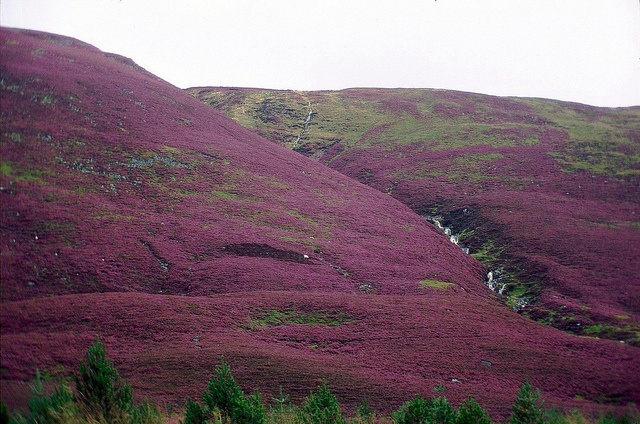
“Wild Mountain Thyme” is a Celtic folksong, and exists in several other adaptations including “The Braes of Balquhither,” and “Will Ye Go, Lassie, Go?” It has been set here for concert band to depict the beautiful purple flowers of the heather plant which cover much of the Scottish countryside during the late summer months.
Scottish hillside covered by heather flowers
O the summer time has come And the trees are sweetly blooming And wild mountain thyme Grows around the purple heather. Will you go, lassie, go?
And we’ll all go together, To pull wild mountain thyme, All around the purple heather. Will you go, lassie, go? I will build my love a tower, By yon clear crystal fountain, And on it I will pile, All the flowers of the mountain. Will you go, lassie, go?
I will range through the wilds And the deep land so dreary And return with the spoils To the bower o’ my dearie. Will ye go lassie go ?
If my true love she’ll not come, Then I’ll surely find another, To pull wild mountain thyme, All around the purple heather. Will you go, lassie, go?
I first came across this tune when I was commissioned to write a piece for percussion by a friend and colleague, Kyle Spence. Kyle was on the band staff at Joe E. Newsome High School during my final year as Director of Bands. At the time he was working on a dual masters in conducting and percussion performance from the University of South Florida, and he wanted a new piece to premiere on his masters recital.
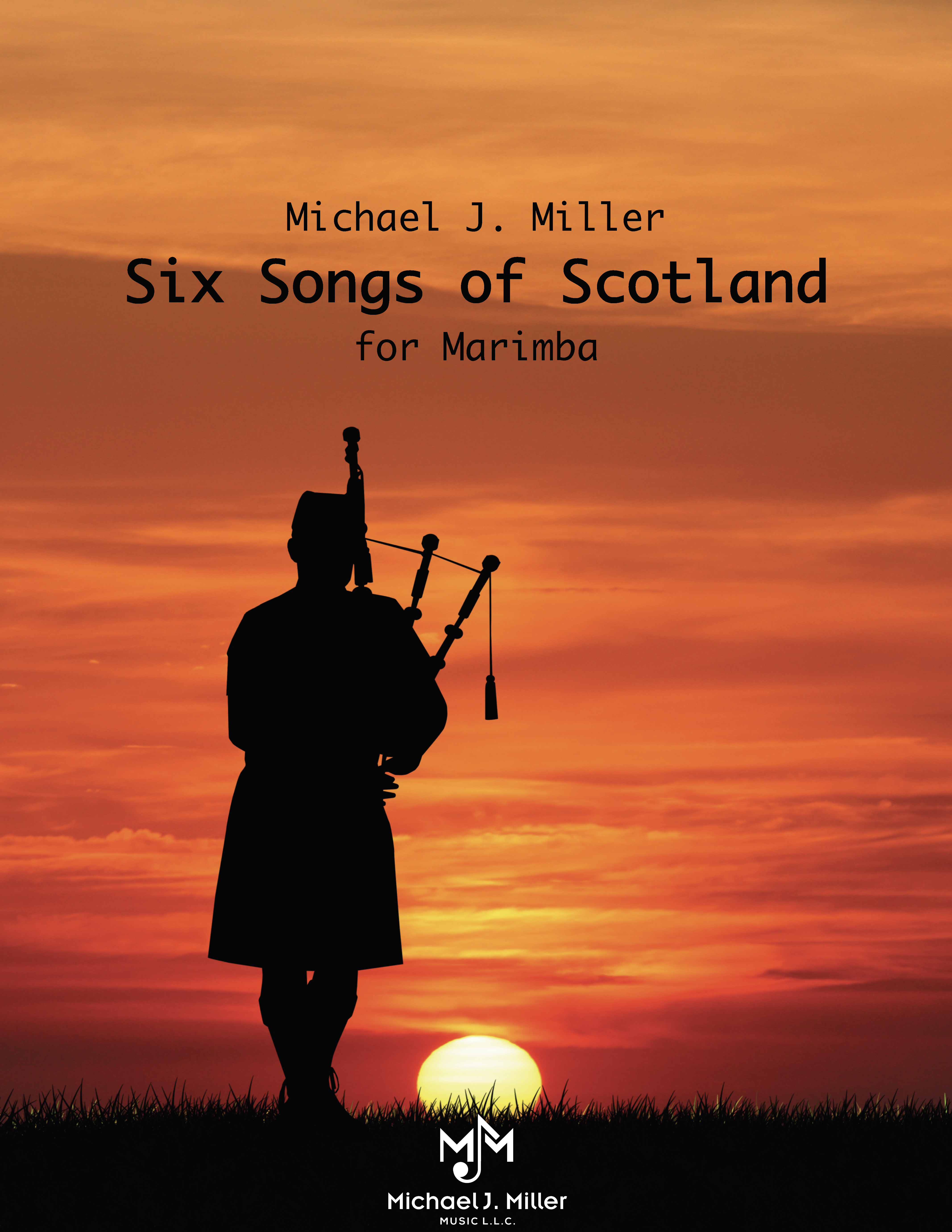
With almost no parameters for the commission, and a desire to develop my compositional chops for marimba due to a growing career as a pageantry arts designer, I settled on a piece for solo marimba. Kyle, who owns his own five-octave rosewood marimba which he somehow transports in his shoebox of a car, is a first generation Scottish American (though he doesn’t sound like it). I therefor decided to use Scottish folksongs as the basis of this new work. And so, SIX SONGS OF SCOTLAND was born. And no, the alliterative title wasn’t an accident.
I chose the following tunes for Kyle’s piece:
“Auld Lang Syne”
“Flower of Scotland”
“I Love A Lassie”
“Scotland the Brave”
“The Bonnie Banks O’ Loch Lomond”
“Wild Mountain Thyme”
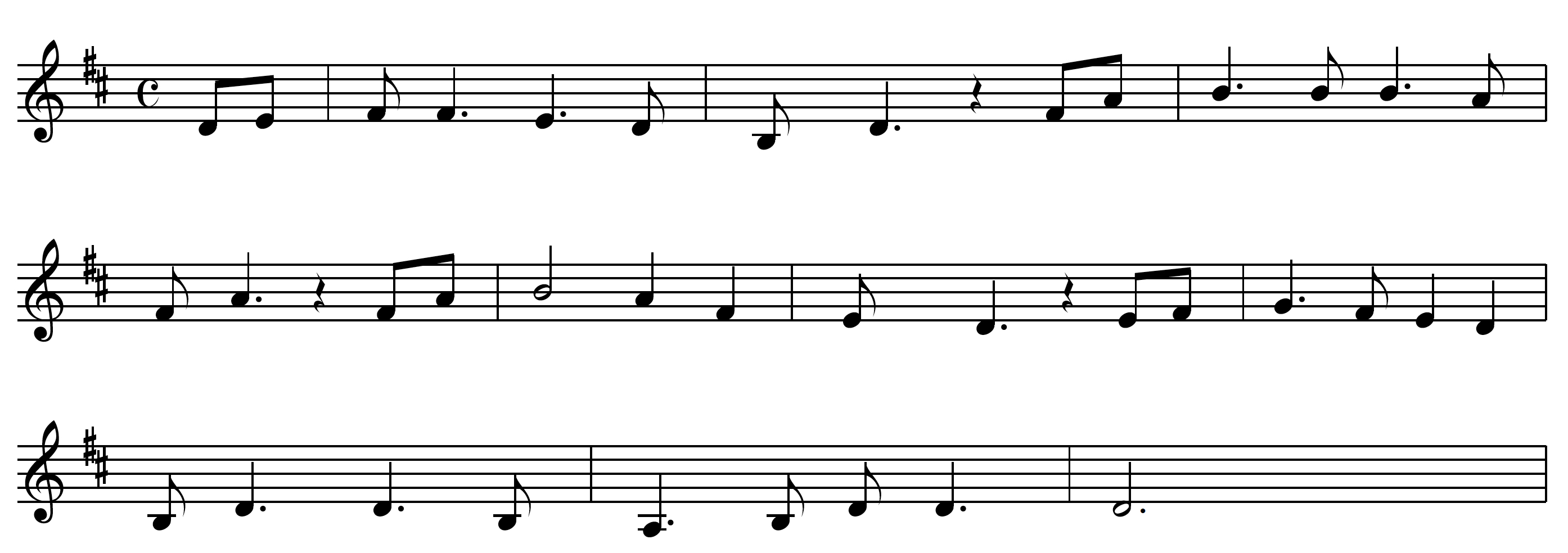
I was particularly drawn to “Wild Mountain Thyme” due to its tuneful melody. It is largely pentatonic, though the subdominant scale degree is used just once in the penultimate phrase which creates a wonderful resolution into the melody’s conclusion. Also, I find the recurring syncopation of the first two eighth-notes in the bar to be unique and catchy.
“Wild Mountain Thyme” melody
There is a ton of educational value in programming a piece such as PURPLE MOUNTAIN HEATHER, especially for younger musicians. It gives them the opportunity to learn music from different parts of the world, exposing them to other cultures and ways of life; it teaches them about people and places they might otherwise have never experienced; and it provides a chance for instrumentalists to develop their musicality through song.
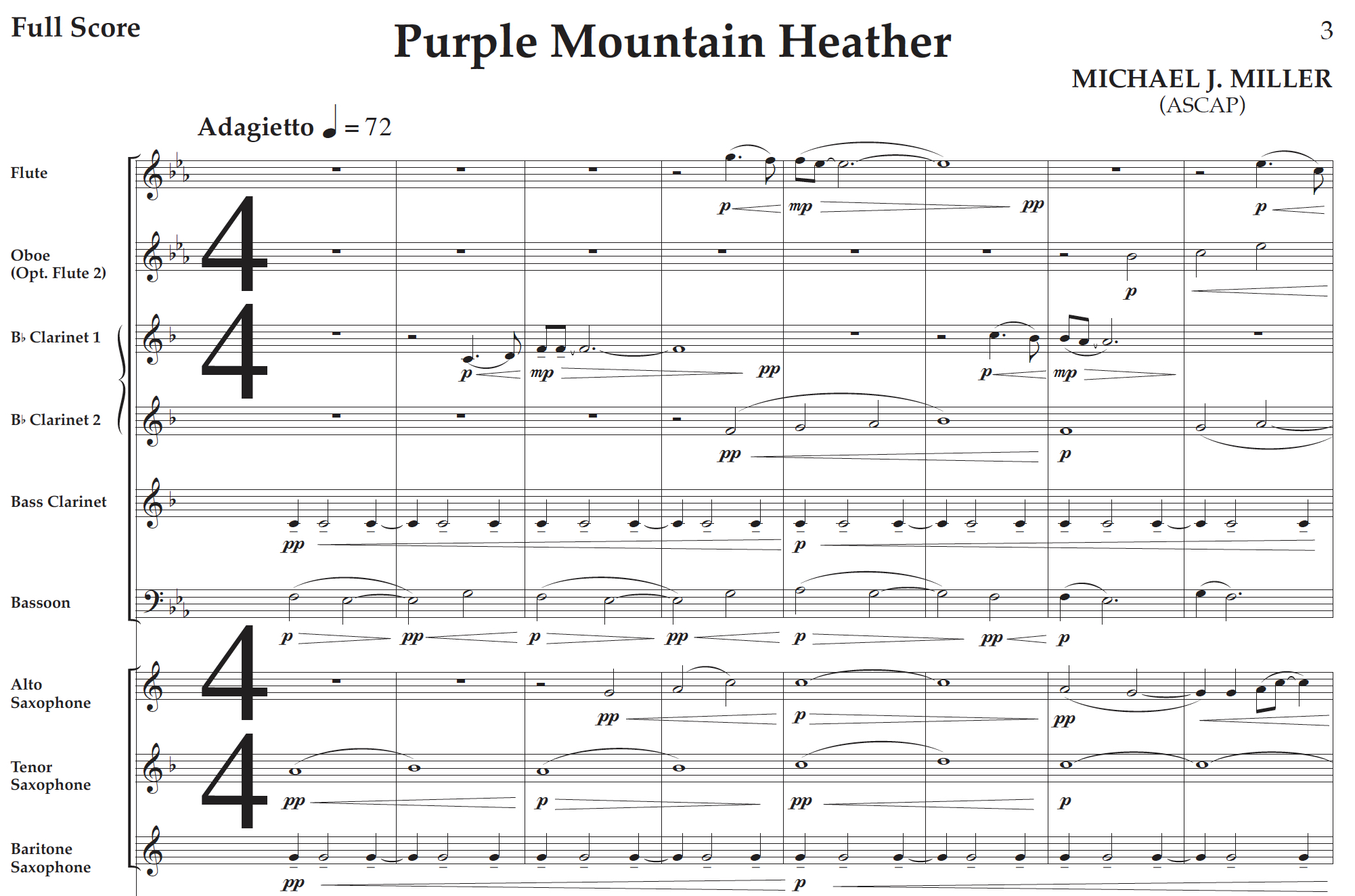
PURPLE MOUNTAIN HEATHER begins with a twelve-measure introduction of harmonic suspensions and melodic fragments passed throughout the ensemble over a pulsing weak-beat pedal-point on the dominant scale degree. The key center here is E-flat major, one of the best keys for a concert band. The counterpoint created by the melodic fragments gets busier as the intro unfolds, culminating with a half-cadence and diminuendo into a vibraphone pedal-point on the dominant scale degree.
PURPLE MOUNTAIN HEATHER; m. 1-8 (woodwinds)
The tune is then heard in single phrases alternating between a solo flute and solo alto saxophone. A subtle chime sounds between each of these phrases, reminiscent of a far-off kirk bell (kirk is the Scottish word for church). At measure 25, the rhythm of the chime accelerates as the final melodic phrase is mimicked in a cascading motion throughout the ensemble. This resolves into the first full ensemble statement of the principal theme at measure 30.
Here, the 1st trumpet carries the theme with most of the doubling shared between the 1st and 2nd clarinets. This section utilizes a fair amount of counterpoint and shaping the hold the interest of the performers as well as audience members.
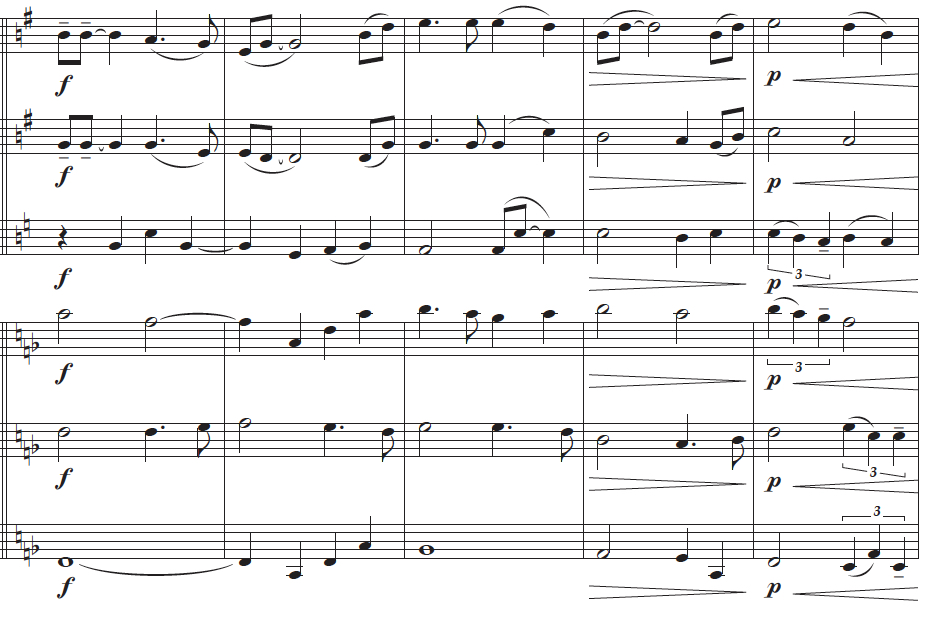
A dramatic modulation occurs during a ritardando in measures 40 and 41, arriving in the key of F major (another great key for band) at measure 42. Here, the 1st trumpet and clarinet share the principal theme which is harmonized by the 2nd clarinet and trumpet. The flute and oboe voices play a soaring descent, the alto saxophone and horn a counter-melody, and for a few bars, the bassoon, and euphonium the tune of “The Bonnie Banks O’ Loch Lomond.”
PURPLE MOUNTAIN HEATHER; m. 42-46 (brass)
The piece comes to a climax at measure 48 at the end of a molto ritardando when the bass voices resolve down to a Bm7 chord. The next few measures (m. 50-54) augment the melody’s rhythm to accentuate the use of the aforementioned subdominant scale degree, and to resolve the previously created volume and harmonic tension.
As creative repetition generally makes for memorable music, Mmeasure 54 and 55 mimic measures 25-29, and measures 56-63 echo the introduction. The music is brought to a subtle close by solo trumpet harmonized with a plagal cadence.
You might be wondering, “why call it Purple Mountain Heather and not Wild Mountain Thyme or one of the other familiar titles of the folksong?” There is an adaptation of this tune by another composer (of a higher degree of difficulty) that goes by the name MOUNTAIN THYME. Plus, I like to think purple is universally appealing color.
ALPINE MEMORIES recorded by Excelcia Music PublishingALPINE MEMORIES published by Excelcia Music
ALPINE MEMORIES is a fantasy on traditional folksongs from the alpine region of Germany, Austria, and Switzerland. A grade 3 piece for band, it was premiered in January of 2018 by the 9th and 10th-grade Hillsborough all-county band in Tampa, FL. The premiere performance was conducted by my longtime friend, Dr. Justin Mertz. Justin and I met during my undergrad at Syracuse University when he took a post as the Assistant Director of Bands and Director of Athletic Bands. Justin was one of the first people to encourage my curiosity as a composer, programming several of my arrangements during his more than ten years with Syracuse’s Pride of the Orange Marching Band. I will always be grateful for his belief in me.
My wife, a first-generation German-American, grew up visiting Germany with her family. On one such trip she purchased an anthology of Germanic folk music called Das groß Buch der Volkslieder or The Big Book of Folksongs. I spent several days playing through the book’s many melodies at the piano, sketching some of them for winds, eventually honing in on three for this work.
Why this piece? I’ve always admired band music based on folksongs, especially that of Gustav Holst, Percy Aldridge Grainger, Pierre LaPlante, and Clare Grundman. I’ve also had the opportunity to visit the European Alps, and have grown quite fond of German culture ever since. In fact, I enjoy German food (and beer) so much I tend to seek out German restaurants wherever I travel including once in Sydney, Australia!
The piece begins with a brief introduction derived from Deutschlandlied, the German national anthem. In E-flat major, the band should be able to present a sonority that is strong, confident, and prideful.
The first folk tune presented thereafter is Oh du lieber Augustin.
O, you dear Augustin, Augustin, Augustin, O, you dear Augustin, all is lost! Money’s gone, girlfriend’s gone, all is lost, Augustin! O, you dear Augustin, all is lost! Coat is gone, staff is gone, Augustin lies in the dirt. O, you dear Augustin, all is lost! Even that rich town Vienna, Broke it is like Augustin; Shed tears with thoughts akin, all is lost! Every Day was a feast, now we just have the plague! Just a great corpse’s feast, that is the rest. Augustin, Augustin, Lie down in your grave! O, you dear Augustin, all is lost!
Though a bit morbid in subject, the treatment of this tune is much more positive. A polka-like “oom-pah-pah” persists throughout over which melodic material flows. Respecting the grotesque nature of the legend of Augustine, a Viennese musician who was nearly buried alive, the third iteration of the tune is in the relative minor. This section climaxes after modulating to a recapitulation in F major.
A playful transition settles in the parallel minor where the second section begins, the source for which is Zu Mantua in Banden (also known as Das Andreas Hofer Lied). The anthem of Tyrol, an Austrian state, this song pays homage to Andreas Hofer, the leader of an early 19thcentury rebellion who was put to death by Napoleon. The woodwind and brass-choirs alternate statements before the full ensemble swells to a passionate climax in A-flat major.
At Mantua bound the loyal Hofer was. At Mantua into death his enemies him led. With bleeding hearts his brothers were, All of Germany dishonoured and in pain And with it its land Tyrol, and with it its land Tyrol.
Augustin’s theme briefly returns one final time via clarinet duet before the third and final section of the piece abruptly begins. Suddenly in B-flat major, a piccolo solo introduces the closing tune, Krambambuli, an 18th-century German fraternity drinking song. True to its origins, the treatment of this song is boisterous, jovial and highly spirited.
Krambambuli is the name, Of the drink, which is preserved with us; It is a very effective remedy, If we suffer evil. In the later evening in the early morning, I drink my glass of krambambuli, Kram-bim-bam-bambuli, Krambambuli.
The piece comes to a dramatic close after a rapid accelerando. The Presto (m. 212) should be played as fast as possible without sacrificing accuracy, providing a riveting end for all to enjoy.
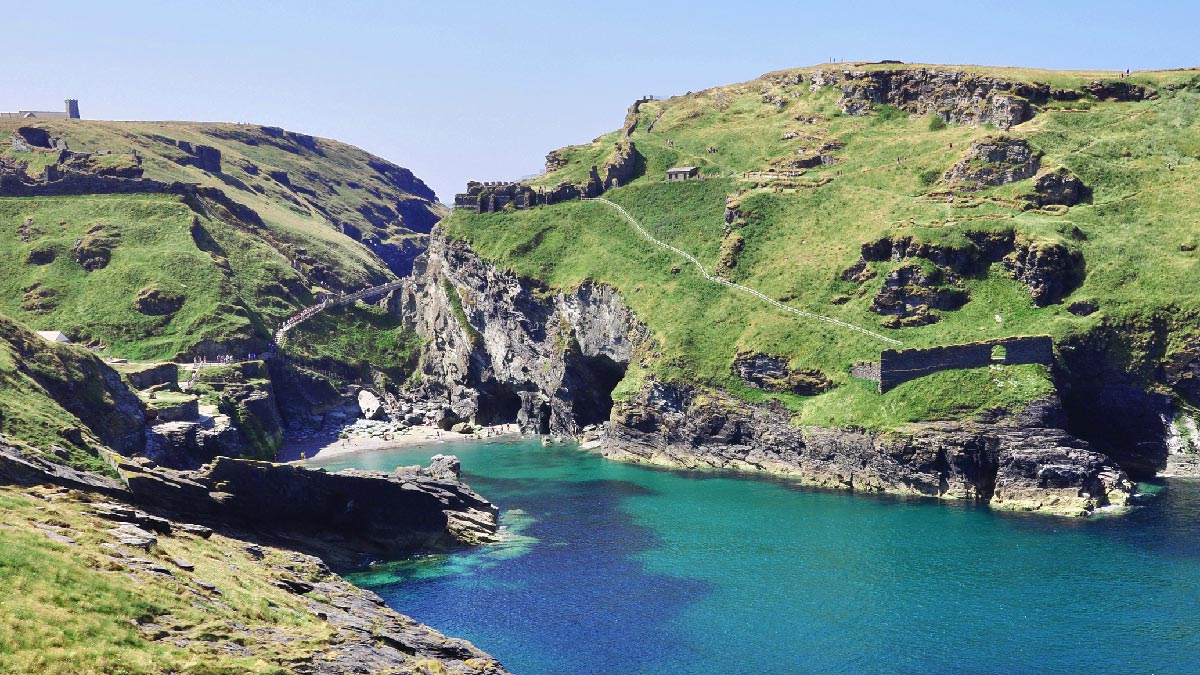
My wife, Vivian is a cultural anthropologist and museologist with a PhD in Applied Anthropology from the University of South Florida. Her dissertation research focused on heritage and tourism at two sights in the United Kingdom. One of these sight was Tintagel in the county of Cornwall. Among other things, Tintagel is home to the ruins of a medieval castle which sits high atop the cliffs overlooking the Atlantic coast. An English Heritage sight complete with a tiny museum and gift shop, Tintagel castle is the rumored birthplace of the infamous King Arthur.
Tintagel Castle ruins
As Vivian spent several weeks “across the pond” conducting her research, I took every opportunity I could to fly over and experience things with her. One day, while she was observing tourists visiting the castle, I decided to embark on a hike along the cliffs near where we were staying. The Cornish coastline is covered in hiking trails, and the views are second to none.
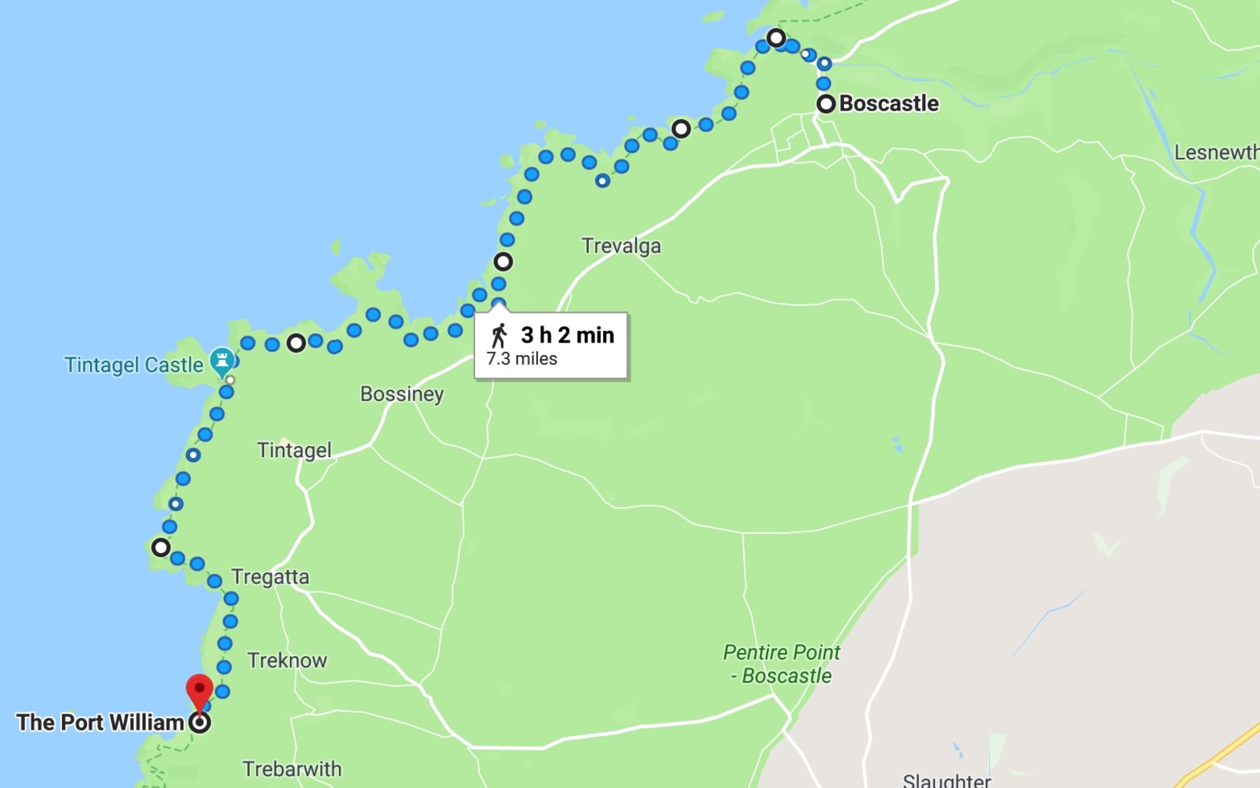
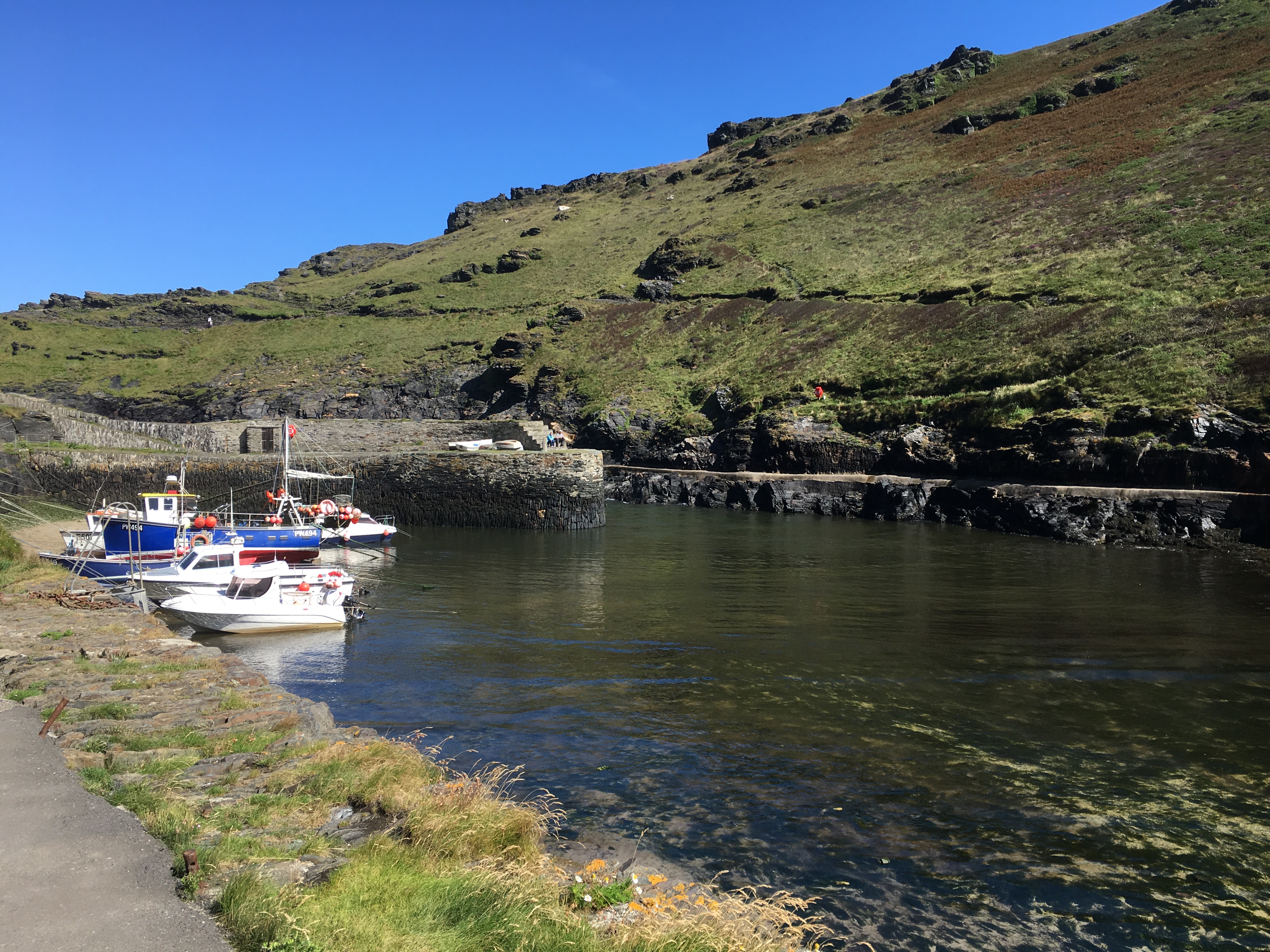
Before going to Tintagel that morning, Vivian dropped me off just a few kilometers away in the fishing port of Boscastle where we visited a few days prior for lunch and the most delicious blackcurrant Cornish ice cream. The plan was for me to make the ~7 mile hike, and meet up with her in a few hours for lunch at the Port William Tavern in Trebarwith which lies just over the hill from Tintagel. They have the best fish-and-chips I’ve ever had (and I’ve had several).
Boscastle to Trebarwith
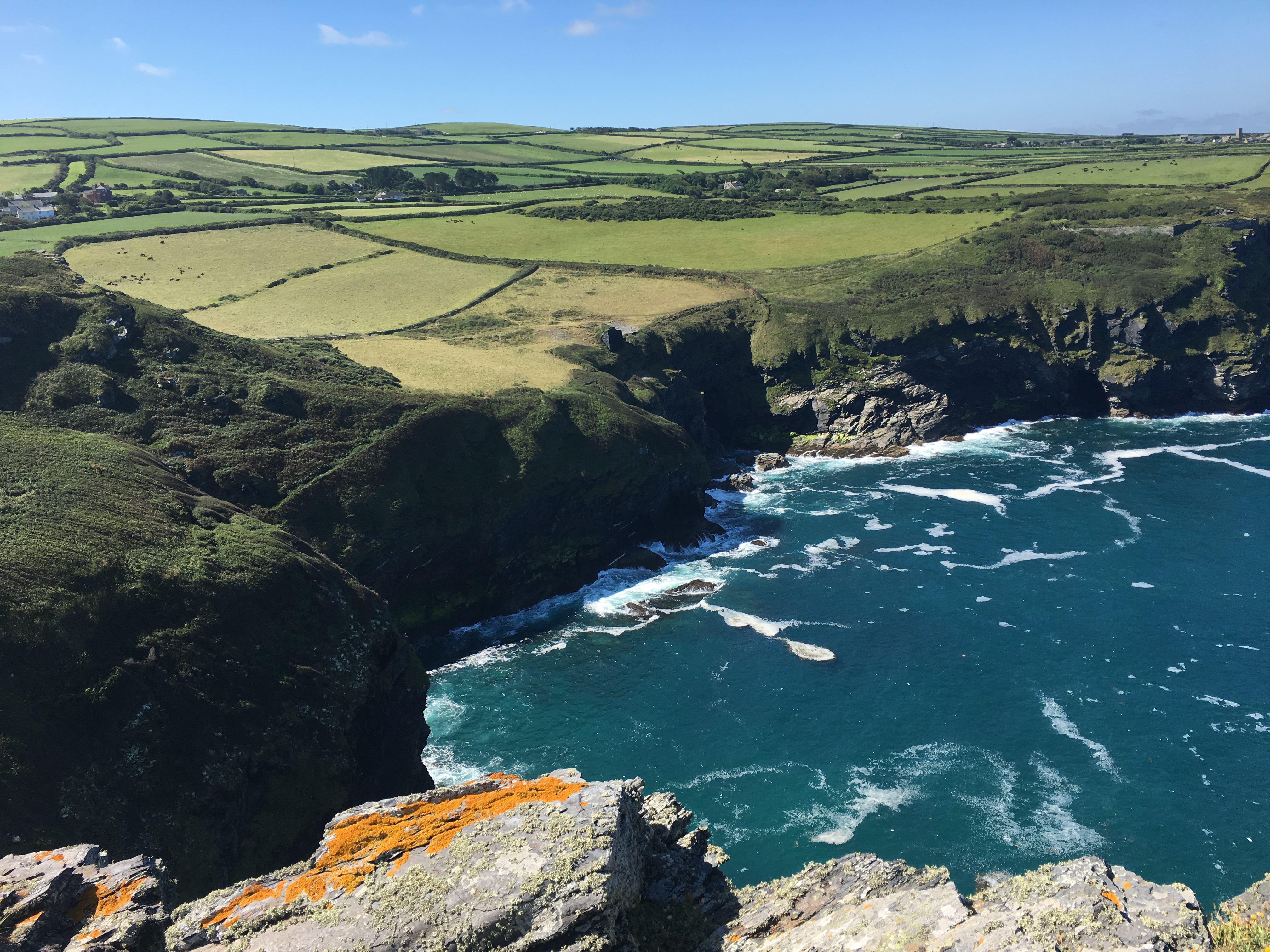
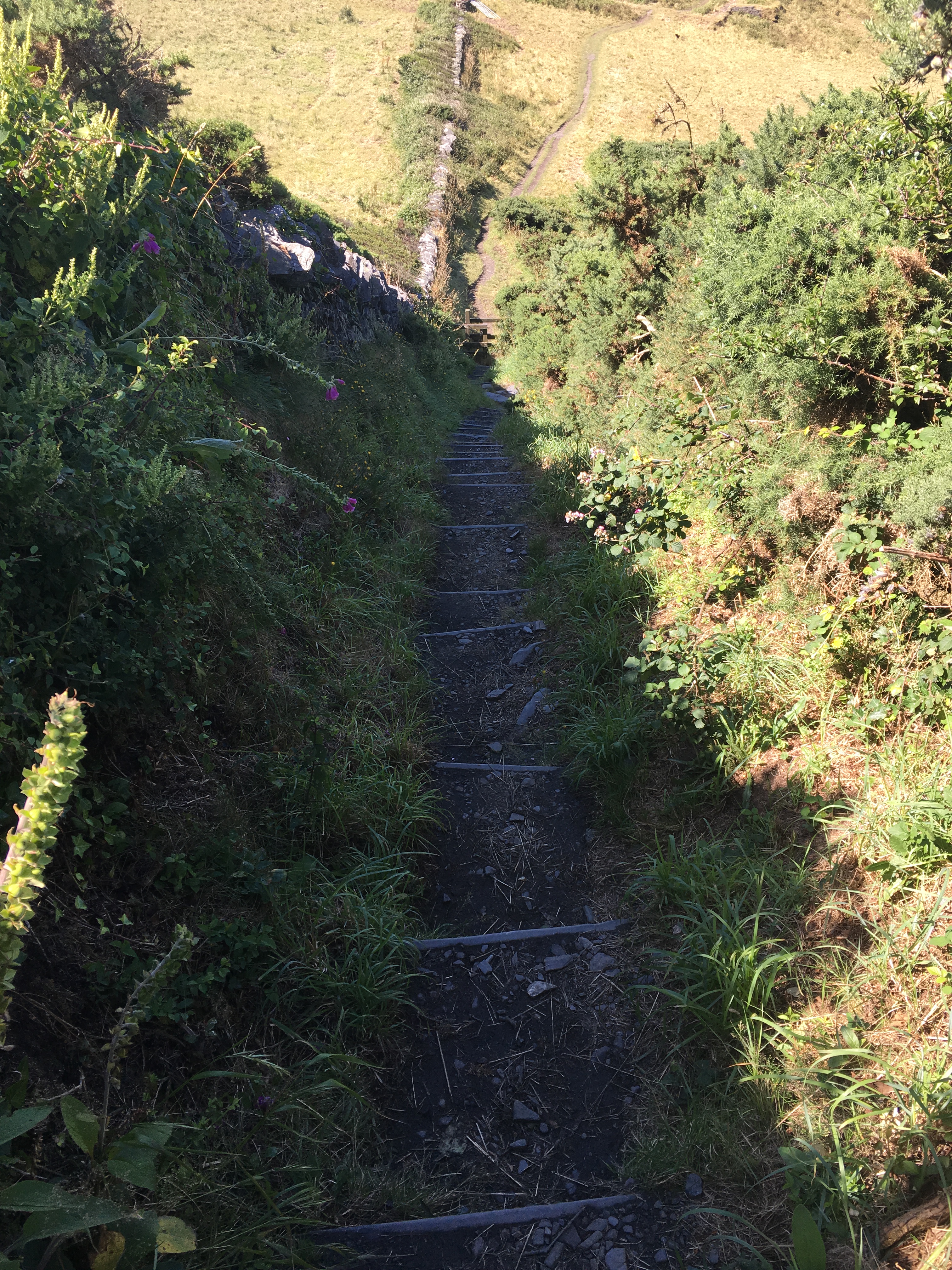
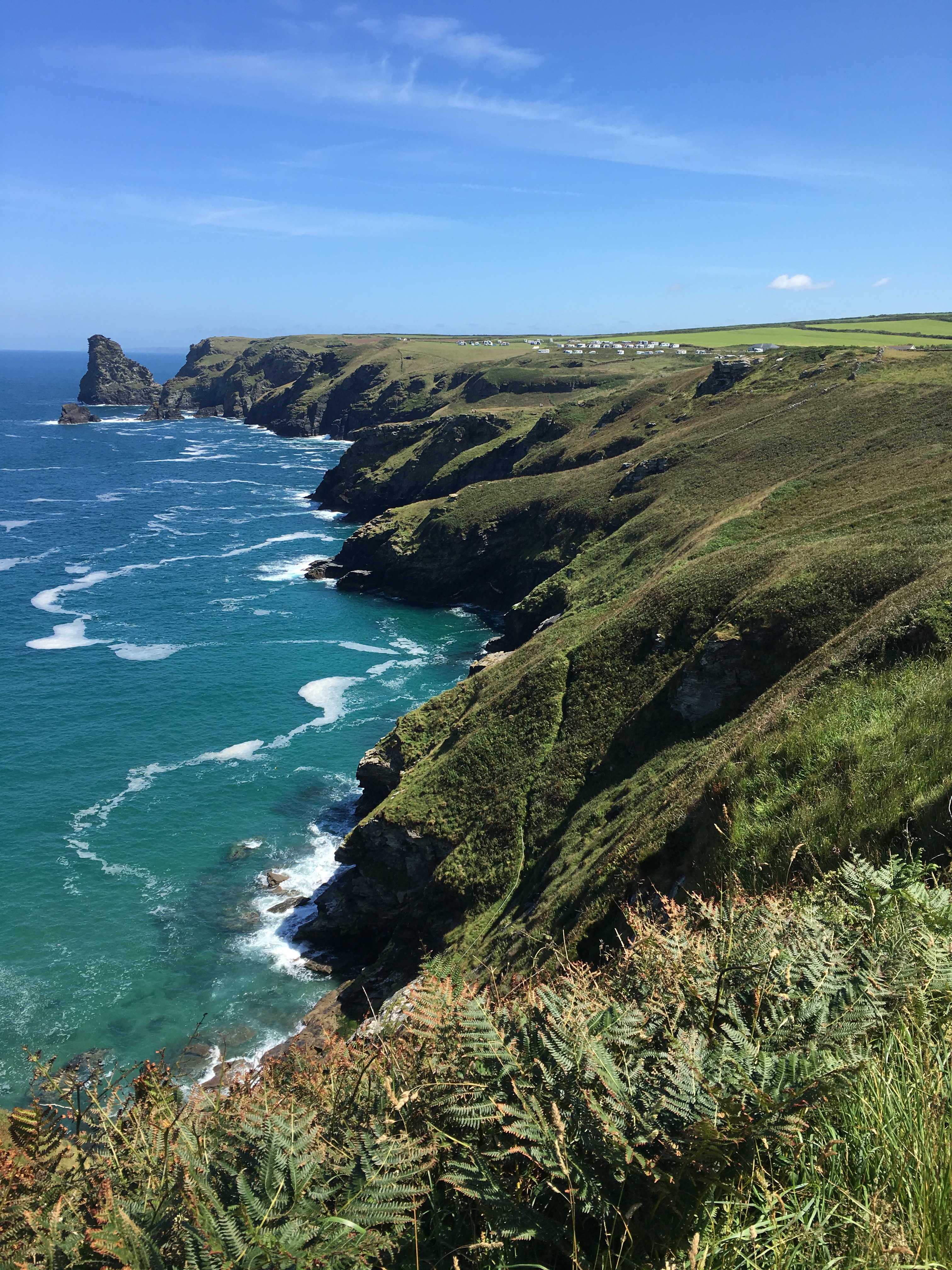
It was a beautifully sunny day, quite hot, and the terrain was bit more extreme than I had anticipated. I ignorantly expected the path to be relatively flat and even, but it twisted and climbed over hills, across open fields, and through rocky valleys. The “walk” definitely requires a bit of stamina, but the scenery is absolutely worth it.
Boscastle Port
Overlooking the walk
Steep descent
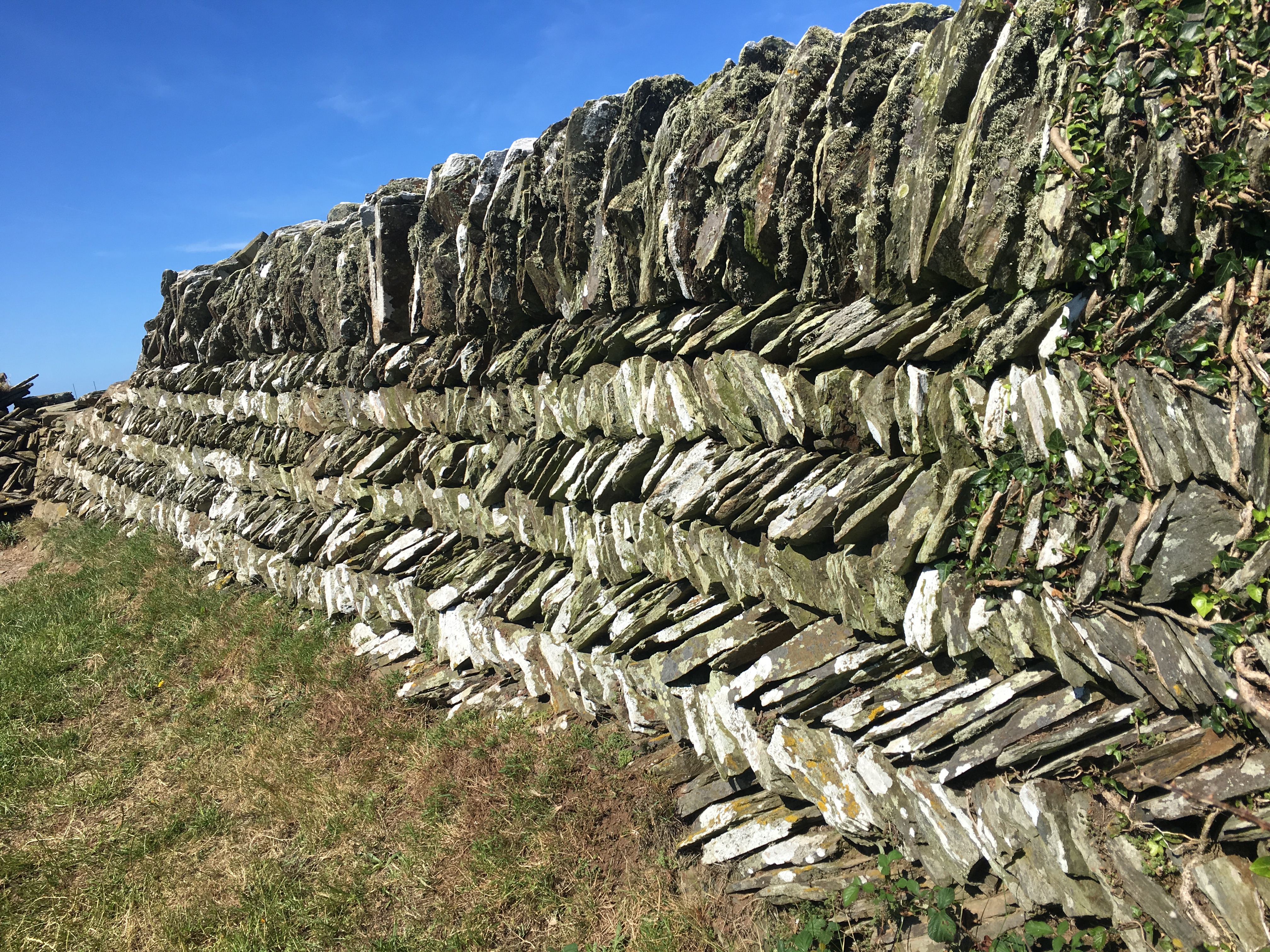
Cornish stone wall
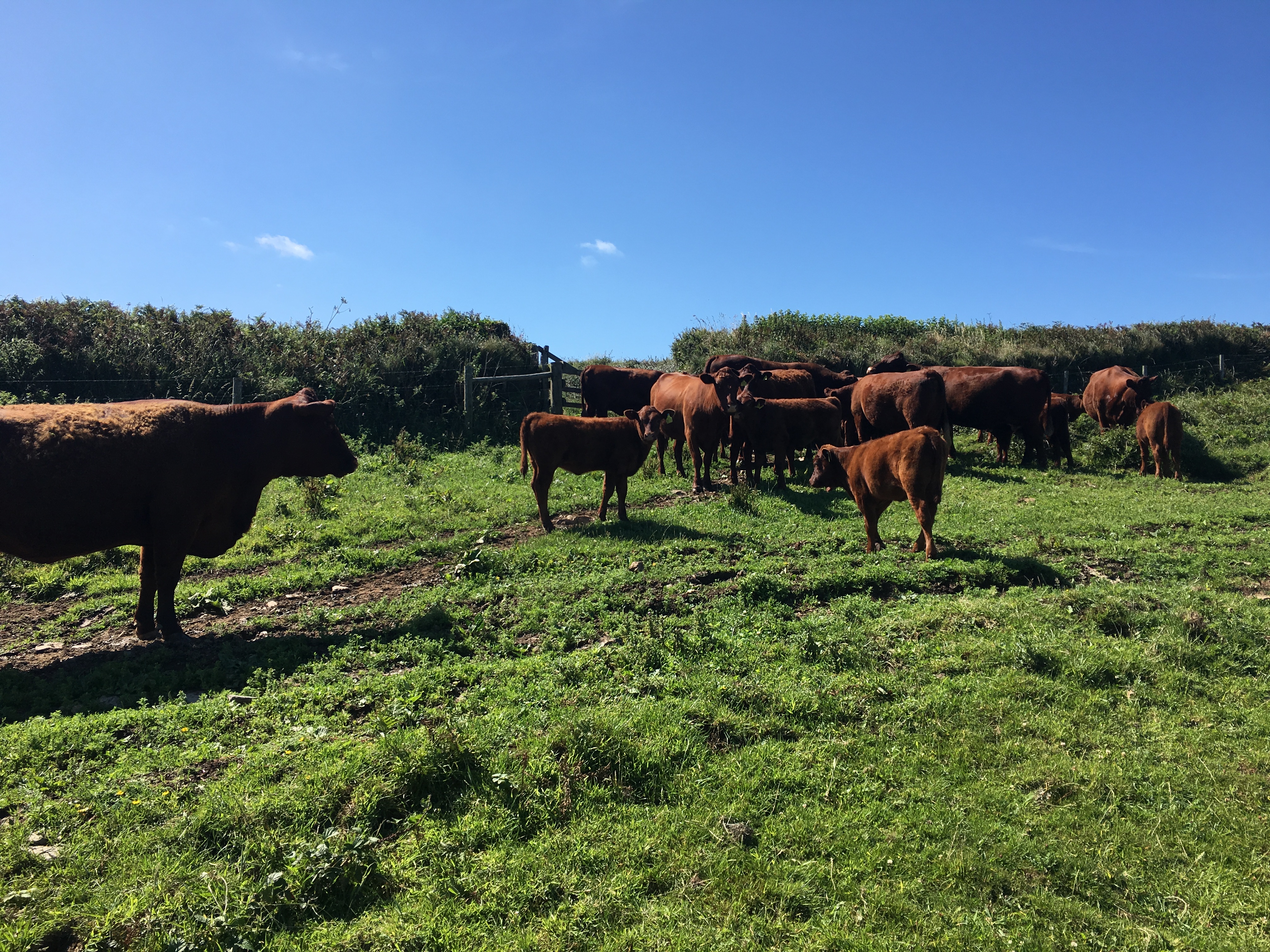
Cows!
Looking backwards
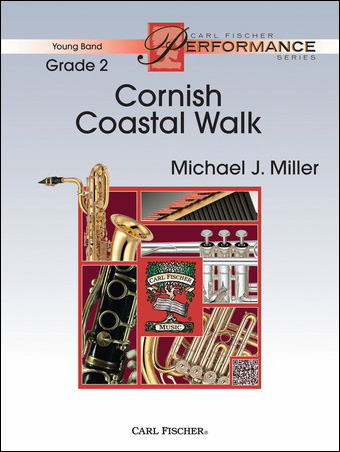
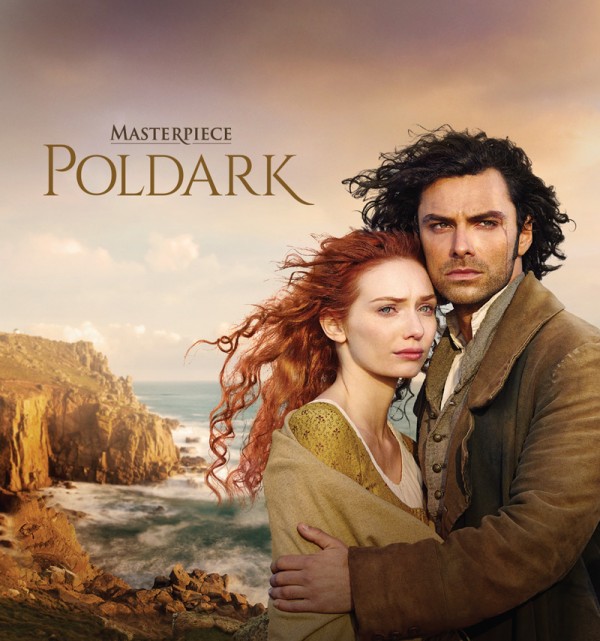
When I was asked by my editor at Carl Fischer Music to write a grade two piece for band, I thought immediately about this trek, and decided it would work well as the subject for this project. But what do the Cornish cliffs sound like? Well, thankfully Vivian had recently turned me on to Masterpiece’s remake of Poldark on P.B.S. The drama follows protagonist Ross Poldark through the trials of being an 18th-century soldier, coal miner, revolutionist, husband, and parliamentary gentlemen. It’s quite good and worth watching.
“Poldark”
Upon beginning CORNISH COASTAL WALK, I thought about the theme music for “Poldark.” It’s romantic, slightly Celtic, and full of drama. I remembered the few times in the show when Ross and other characters crossed the English Channel to France, leaving their loved-ones to look out over the sea wondering if they would ever be reunited. I also recalled the second movement of Gustav Holst’s Second Suite for Military Band, a setting of the folk tune “I’ll Love my Love” in which a young woman is committed to an asylum by her lover’s parents and patiently awaits his return from sea.
Oh cruel were his parents Who sent my love to sea And cruel was the ship That bore my love from me: Yet I love his parents since they’re his Although they’ve ruined me.
Second verse of folk song “I’ll Love My Love”
The opening theme bookends the composition. In the introduction it ends on a C minor chord as a half cadence in F minor. Here it’s purpose it to set a sorrowful mood. This theme returns in measure 79 again in C minor, but this time resolves via Picardy third ending on a triumphant C major chord. The piece wasn’t composed to tell a specific story, but if it did it would be in its final measure when the two long-lost characters are reunited.
Opening theme (m. 1-12)
The introduction closes with a rallentando and fermata before the low winds and percussion establish a minuet style dance (m. 13) over which the clarinets begin the primary theme (m. 17) and the flute, oboe, and alto sax finish (m. 25-32). The low winds are featured with the secondary theme (m. 33) during which the orchestration gradually thickens and builds before releasing tension into measure 41.
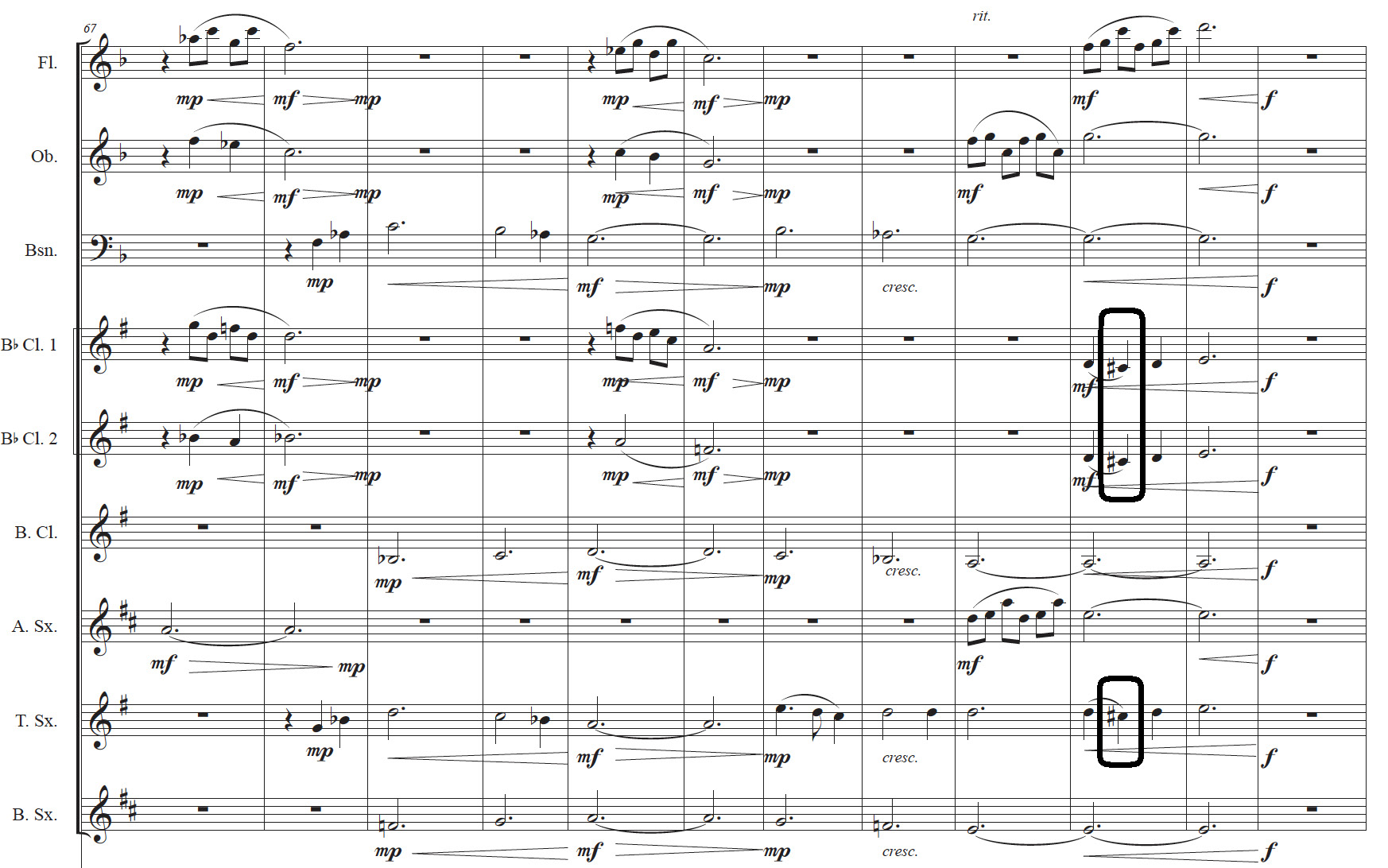
The primary theme is heard again beginning at measure 41, this time played by the flutes and oboe. Here there is a new countermelody played only by the tenor saxophone. Then, the second half of the primary theme is played by solo trumpet and accompanied by solo flute and clarinet (m. 49). The secondary theme is again played by the low voices beginning at measure 57, only this time it’s embellished by a few extra notes. The trumpets begin a development section at measure 65 which ultimate leads to a dramatic rallentando and crescendo before the conclusion of the work. The introduction of the concert B-natural accidental in measure 76 helps move the harmony through a modulation into the aforementioned reiteration of the introductory theme.
B-natural accidental at the end of development section (m. 67-78)
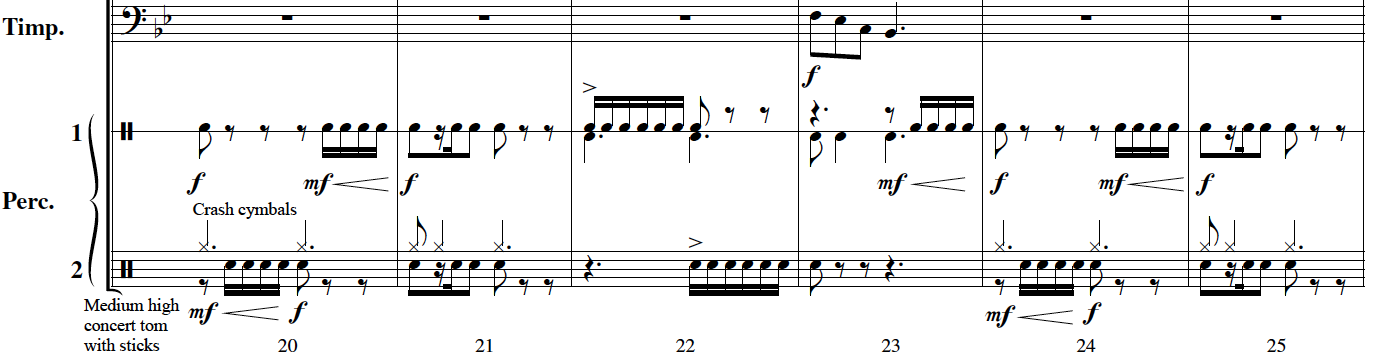
Around the Spring of 2015 I programed a percussion ensemble for the Florida Bandmasters Association’s district solo and ensemble music performance assessment. The piece was for four or five percussionists, and included independent technical passages passed from player to player. I sought to practice this technique by composing a work for concert band, and began writing what I thought was a fanfare.
Percussion interlude in Cosmic Expedition
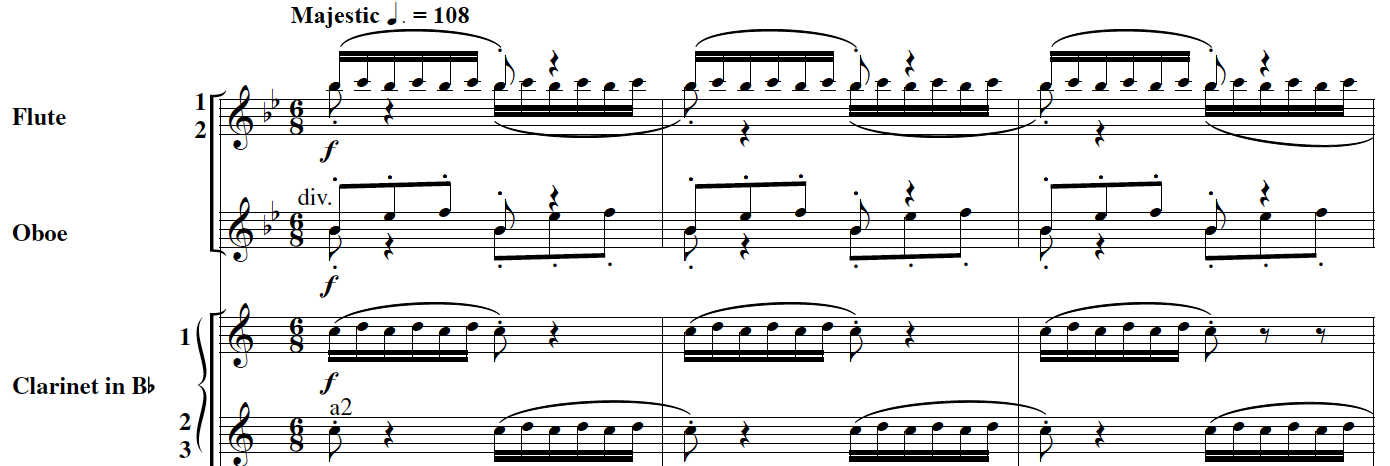
I knew I wanted syncopated brass statements and busy percussion parts, but was initially unsure of what to do with the woodwind voices. I created what I call a sound-screen by scoring repeated two-note fragments alternating in divisi. When properly balanced the result sounds like a written-out trill. The rest of the piece wrote itself over a few busy months of high school band directing.
Sound-screen at the opening of Cosmic Expedition
In the end I had a piece that to me sounded like an adventure. After googling some synonyms I settled on the title Expedition for Band. My only other publication for band at the time was Tribute for Band with Alfred Music, so I sent Expedition off to Bob Sheldon and Alfred’s acquisition team. Unfortunately, however it didn’t fit their needs at the time.
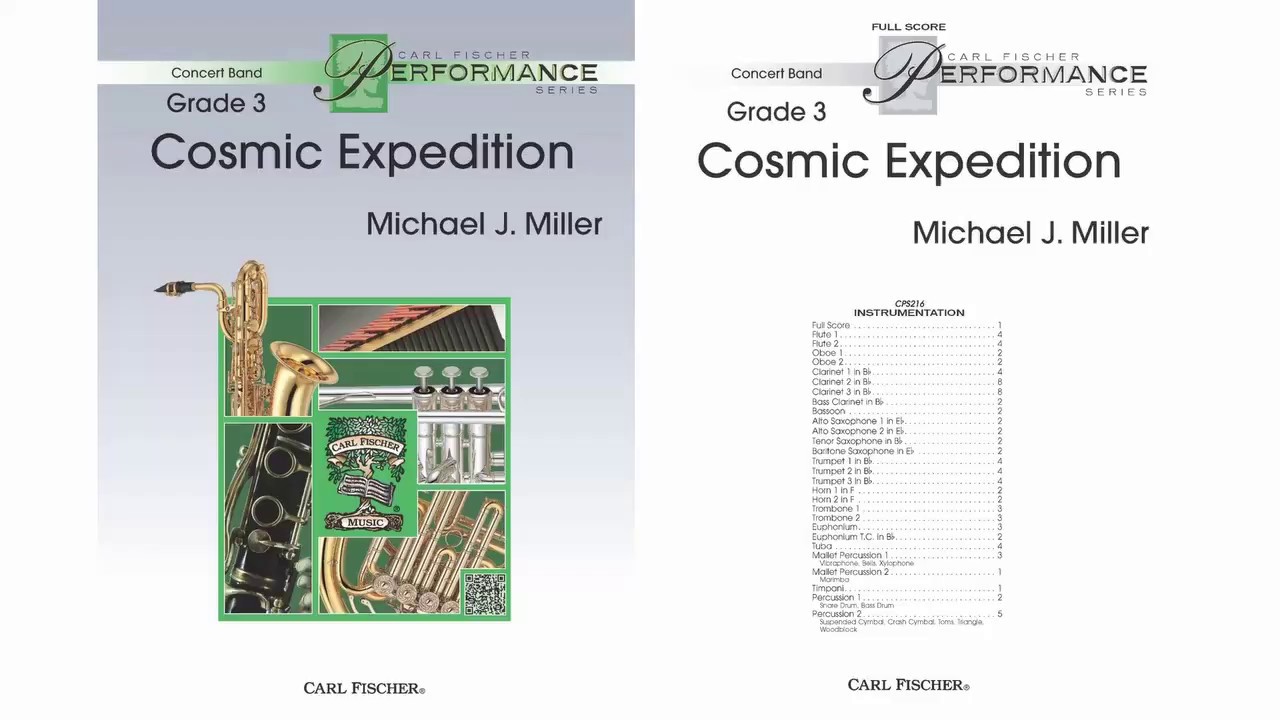
Years back through a mutual acquaintance I had met Larry Clark, then Vice President and chief concert band editor for Carl Fischer Music. So I sent Expedition to Larry to see what he thought of it. I was delighted when he agreed to publish it. It was in our initial correspondence that Larry expressed the importance of a marketable title (a future blog post). Expedition, he said, was too generic. So I turned to the one person I trust in helping me with titles, my wife. Without telling her anything about the piece, I asked her to listen and react on what she heard. Her response? “It sounds like Star Wars.” Cosmic Expedition was born.
Cosmic Expedition published by Carl Fischer Music.
Before being renamed and accepted for publication, Expedition had received two performances. Its official world premiere was done by the University of Florida Symphonic Band conducted by John “Jay” Watkins. It was later performed by Dr. Matt McCutchen’s University of South Florida based B.A.Y. (Bay Area Youth) Winds high school honor band.
Unbeknownst to me at the time, Jay Watkins was in charge of acquiring commissions for Phi Beta Mu International Bandmasters Fraternity. When he asked to give Cosmic Expedition a commission, I gratefully accepted. Some months later I was informed that the commission would be premiered at the 2018 Midwest Band and Orchestra Clinic by the Texas based Woodlands Concert Band. What’s more, it was to be conducted by Richard Crain, President of the Midwest Clinic!
Me and Richard Crain at the Wednesday night rehearsal before Midwest performance.
As this was my first performance at Midwest it will forever remain one of the most special concerts I’ve ever attended. It went beautifully, and was extremely well attended. I was quite nervous beforehand, and am now eternally grateful for the experience. Here’s to (hopefully) many more!
In the spring of 2015 I had the honor of meeting John O’Reilly, composer and former chief concert band editor for Alfred Music. John’s granddaughter was an oboe player in my band at Joe E. Newsome High School. John had emailed me earlier in the year about playing some of his music, and I happily obliged. The concert was framed as a guest composer concert, and we played at least one of his pieces with each ensemble.
As I myself was (and still am) an aspiring composer, I took it upon myself to program my Tribute for Band. While at lunch between rehearsals I asked John if he thought it was publishable. His response: “Send it to my friend Bob Sheldon.” Bob is the chief concert band editor for Alfred Music. Opportunity knocked, so I opened the door. I sent a draft to Bob, and to my delight he liked it enough to add it to Alfred’s 2017 catalogue. I was and will forever be grateful to John for connecting me with Bob, and to Bob for fulfilling my lifelong dream of being picked up by a major music publisher. I’ve since worked with multiple publishers, have self-published, and am learning the ins and outs of the business (future blog post).
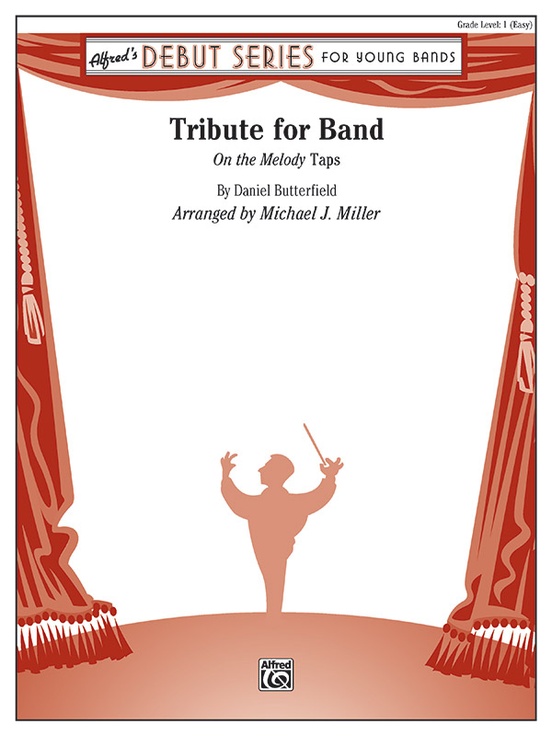
Cover of Tribute for Band published by Alfred Music
Tribute for Band isn’t a true “composition” because it’s an arrangement of previously existing music. It uses the famous bugle-call melody Taps which was originally composed by Daniel Butterfield. The simple tune consists of many long sustains over which I incorporated various other patriotic quotes including Simple Gifts, Battle Hymn of the Republic, The Star Spangled Banner, and Amazing Grace. The Taps theme is presented twice with a dramatic modulation in the middle.
Composer tip: Tuneful melodies and creative repetition are paramount when composing approachable music for scholastic ensembles. I always sensed this, but it was Larry Clark, previous Vice President and Editor at Carl Fischer Music and now owner of Excelcia Music that instilled this in me during one of our early conversations (another future blog post).
I originally wrote this arrangement to honor the life of a long time friend and colleague, Bruce McCready. Bruce was a veteran of the U.S. Army, serving from 1966 to 1967 in Korea. He retired as the Dean of Students at Marcus Whitmas High School in Rushville, NY, and was a beloved educator and adjudicator in the pageantry arts. Bruce was one of my instructors when I performed with the Syracuse Brigadiers Drum and Bugle Corps from Syracuse, NY. The Brigs were the first to play the piece when it was called Tribute and scored for a choir of G bugles!
TRIBUTE FOR BAND can be acquired directly from Alfred Music or from the music distributer J.W. Pepper. For more about me, my music or to commission a new work please visit my website, Michael J. Miller Music L.L.C.





 Michael J. Miller, Composer